



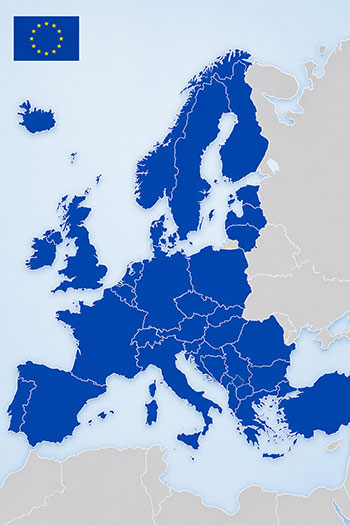









Europe eSIM and Travel Guide: Stay Connected Across the Continent
Essential travel information, mobile internet advice and useful tips for your journey to Europe.
Why an eSIM Is a Smart Choice for Your European Journey

Europe offers an incredible diversity of cultures, landscapes, and experiences, from the sun-drenched beaches of the Mediterranean to the majestic fjords of Scandinavia. Whether you are planning a multi-country rail adventure, a city break in historic capitals, or a remote-work retreat in a picturesque village, staying connected is more than a convenience—it is often a necessity. Reliable mobile internet can transform your trip, enabling you to navigate winding medieval streets with online maps, book last-minute accommodation, access digital boarding passes, and translate menus or conversations in real time.
An eSIM is a modern alternative to traditional plastic SIM cards that allows you to activate a mobile data plan directly on your device, often before you even leave home. For Europe, this can mean avoiding the hassle of finding a local SIM shop upon arrival or paying high roaming charges on your primary line. With an eSIM, you can keep your regular phone number active for calls and texts while using the eSIM profile exclusively for data, giving you flexibility without the need to swap physical cards. It is not always the cheapest solution for every traveller, but its convenience and instant usability make it an attractive option for many.
Reliable mobile internet empowers you to handle unexpected situations: checking transport schedules during a sudden strike, finding an alternative route when a road is closed, or accessing emergency assistance with precise location details. It also keeps you in touch with family, friends, or colleagues, and supports the growing trend of combining work with travel. As you prepare for your European trip, an eSIM is worth considering as part of your connectivity toolkit.
Understanding Mobile Internet Coverage in Europe

Europe is one of the most connected continents in the world, with extensive 4G LTE networks covering the vast majority of populated areas. In cities and large towns, you can generally expect stable and fast mobile internet, often complemented by growing 5G availability in many urban centres. However, coverage is not uniform, and the experience can vary significantly between countries and regions. Major tourist destinations like Paris, Rome, Barcelona, or Berlin typically boast multiple network layers, offering robust indoor coverage in museums, restaurants, and public transport systems.
Outside metropolitan areas, the picture can change. In rural villages, along coastal cliffs, or in mountainous zones such as the Alps or the Scottish Highlands, coverage may be limited to 3G or even become patchy in deep valleys or remote nature reserves. Islands—from the Greek Cyclades to the Canaries—often have good coverage near ports and main settlements but can present dead zones on remote beaches or during ferry crossings. Indoor coverage can also be weakened in thick-walled historic buildings, common throughout Europe, or in underground metro stations, though many cities now offer Wi-Fi in such locations.
Network congestion can occur in peak tourist seasons, particularly at famous landmarks, during festivals, or in busy transport hubs. This may temporarily reduce speeds, even if the signal strength appears strong. The actual mobile experience depends on multiple factors: your device’s antenna capabilities, its compatibility with local frequency bands, the specific eSIM plan’s network partners, and even weather conditions. While 5G is expanding, it is not guaranteed everywhere; some eSIM plans may only connect to 4G or may require a 5G-compatible plan and device. Always check the plan details for what is supported.
Key Mobile Network Operators and eSIM Providers in Europe
The European mobile landscape is a patchwork of national operators, many of which belong to large multinational groups. In most European countries, there are three or four main network operators with their own infrastructure, plus a variety of virtual operators that lease capacity from them. Well-established names include Vodafone, Orange, Deutsche Telekom (often branded as T-Mobile), and Telefónica (operating under brands like O2, Movistar). These companies, along with others such as TIM in Italy, Telenor in Scandinavia, and Swisscom in Switzerland, provide the backbone of mobile connectivity across the continent.
When you purchase an eSIM for Europe, the provider typically partners with one or more of these operators to deliver service. The exact networks available to you will depend on the specific eSIM plan you select. Some plans may offer access to multiple partner networks, allowing your device to connect to the strongest signal in a given location, but automatic switching between all available networks is not always enabled. In many cases, the eSIM will be locked to a single roaming partner per country, and manual network selection may be restricted. This is a critical detail: you should not assume that having an eSIM means you can hop between every local network freely.
5G access is also plan-dependent. Even if a local operator has a wide 5G footprint, your eSIM might only support 4G if the agreement between the provider and the operator does not include 5G. Additionally, virtual operators (MVNOs) are common in Europe; they often use the infrastructure of the major networks but may offer different coverage or speed limitations. For example, a plan that uses an MVNO may have lower priority on the network during congestion. Before purchasing, check the eSIM’s list of supported countries and operators to understand what to expect.
Top Destinations and How Mobile Internet Enhances Your Visit

Europe is a treasure trove of iconic sights and hidden gems. Whether you are marvelling at the Colosseum in Rome, strolling along the canals of Amsterdam, or exploring the fairy-tale castles of Bavaria, having reliable mobile internet on your phone can greatly enrich your experience. With an active data connection, you can instantly pull up historical context, queue-jump timed entry tickets, or check real-time opening hours and visitor reviews. Navigation apps help you find less-crowded viewpoints or public transport alternatives when a metro line is unexpectedly closed.
Some of the most visited destinations include:
- Paris: The Eiffel Tower, Louvre Museum, and Montmartre. Use your connection to book skip-the-line passes or a river cruise along the Seine.
- London: The British Museum, Tower of London, and West End theatres. Real-time walking directions can guide you through the city’s labyrinthine streets to a traditional pub.
- Barcelona: Sagrada Familia, Park Güell, and the Gothic Quarter. Check live cams of the beach or book a last-minute tapas tour.
- Prague: Charles Bridge, Prague Castle, and the Old Town Square. Use translation apps to understand Czech signs or menus in local restaurants.
- Amalfi Coast: Picturesque villages like Positano and Ravello. Mobile internet helps you check ferry timetables or find the best photo spots.
Beyond cities, Europe’s natural beauty is staggering. The Swiss Alps, Norwegian fjords, and Plitvice Lakes in Croatia offer breathtaking hiking and sightseeing. In remote areas, offline maps downloaded via Wi-Fi can be a lifesaver, but a data connection allows you to access real-time weather alerts, trail conditions, and emergency services if needed. For island-hopping in Greece or Croatia, mobile internet lets you book ferries on the go, check wind conditions, and find accommodation even during the busy summer months.
Cultural Insights and Practical Tips for Travelling in Europe

Europe is not a monolith; it is a continent of striking cultural diversity. Dining customs vary: in Spain, dinner is rarely before 9 p.m., while in Norway, you might find locals eating as early as 4 p.m. Tipping habits differ—rounding up the bill is common in many countries, but in Italy, a “coperto” (cover charge) may already be included. Being aware of these nuances can smooth your interactions. Mobile internet helps you quickly look up local etiquette, whether it’s how to greet someone in Poland (a firm handshake) or whether you need to validate your train ticket in France (yes, in most cases).
Festivals abound across the continent. From Germany’s Oktoberfest to Spain’s La Tomatina, and from Sweden’s Midsummer to the Venice Carnival, these events can heavily impact transport and accommodation availability. An active data connection allows you to monitor last-minute changes, book alternative routes, or even join in spontaneously. Lesser-known destinations, such as the Baltic capitals of Tallinn, Riga, and Vilnius, often offer a more budget-friendly and authentic experience. Mobile internet makes it easy to navigate these cities with confidence, using public transport apps and local recommendation services.
Transport varies widely: high-speed trains connect major cities, but regional services may require separate bookings. Ride-hailing apps work in many but not all areas, and the rules differ. For example, in some German cities, Uber only operates licensed taxis. With your eSIM, you can switch between local apps without worrying about finding a SIM kiosk. When it comes to safety, keep your primary SIM active for essential calls and texts, but be mindful that receiving calls abroad can still incur roaming charges depending on your home operator’s policy. Using the eSIM for data while keeping your primary line for emergencies is a common strategy.
How to Set Up and Activate Your Europe eSIM
Before purchasing an eSIM, ensure that your device is eSIM-compatible and network unlocked. Most recent models from Apple, Samsung, Google, and other brands support eSIM, but it is important to verify with your manufacturer or carrier. The eSIM installation usually begins with a QR code or manual activation details provided by the eSIM provider. It is highly recommended to install the eSIM profile while connected to a stable Wi-Fi network, as the process requires an internet connection to download the configuration.
Once the profile is downloaded, label it clearly (e.g., “Europe Data”) and set it as the default for mobile data. Many eSIMs for Europe require that you enable data roaming on the eSIM line, even if you are within the EU. This is because the eSIM may connect to a roaming partner rather than a home network. Do not enable data roaming on your primary SIM unless you are absolutely sure about your home operator’s roaming fees, as this can lead to unexpected charges. To avoid accidental usage on your primary SIM, you can disable data on that line entirely and set voice/SMS according to your needs.
Activation timing can vary: some plans become active immediately upon installation, while others only activate when the device connects to a supported network at your destination. Do not delete the eSIM unless the provider explicitly confirms that it can be reinstalled, as many profiles are single-use. Keep your QR code and activation details secure in case you need to re-add the plan. If you encounter connectivity issues after arrival, start with a device restart, then check that the eSIM line is selected for data and that data roaming is on. Manually selecting a network from the eSIM’s partner list can sometimes force a connection. Also verify that APN settings, if required, have been correctly applied. Most eSIM providers offer customer support to assist with troubleshooting.
Ready to travel to Europe?
Choose your eSIM before departure and connect to mobile internet as soon as you arrive.