
Asia Travel Guide 2026 – Singapore, Malaysia, Indonesia, Thailand & Hong Kong
Planning a trip across Asia? This complete travel guide covers Singapore, Malaysia, Indonesia, Thailand and Hong Kong, including the best time to visit, entry requirements, weather, transport, costs, local customs, food, payments, useful travel apps and mobile internet. Whether you are planning a multi-country Southeast Asia trip or combining several destinations in one journey, here is what you need to know before you go.
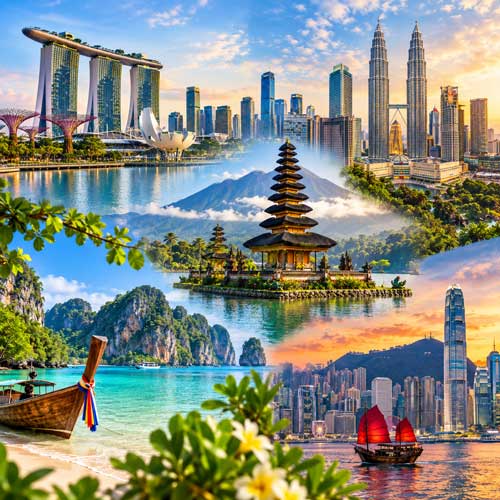
Why visit Singapore, Malaysia, Indonesia, Thailand and Hong Kong?
These five destinations combine some of Asia's most exciting cities, tropical islands, beaches, historic temples, famous street food, modern shopping districts and diverse cultures. You can explore futuristic Singapore, travel through the cities and islands of Malaysia, discover the beaches and temples of Indonesia, experience Thailand's food and nightlife, and finish your journey among the skyscrapers and harbour views of Hong Kong. Excellent regional flight connections also make it practical to combine several of these destinations in a single trip.
Entry requirements and visas for an Asia multi-country trip
Entry requirements vary between Singapore, Malaysia, Indonesia, Thailand and Hong Kong and depend on your nationality, length of stay and purpose of travel. Some travellers can enter certain destinations without obtaining a tourist visa in advance, while other nationalities may require a visa, electronic travel authorisation, arrival form or other documentation. Passport validity requirements can also differ. Because immigration rules can change, always check the latest official government or immigration information for every destination on your itinerary before departure.
When is the best time to visit these Asian destinations?
There is no single perfect month for a trip covering Singapore, Malaysia, Indonesia, Thailand and Hong Kong because weather patterns vary significantly across the region. Singapore and Malaysia are tropical throughout the year, while Indonesia has more distinct wet and dry periods in many areas. Thailand's weather varies between regions and seasons, and Hong Kong has cooler winters and hot, humid summers. For a multi-country itinerary, consider both rainfall and temperature in each destination rather than choosing dates based on only one country.
Weather and climate in Southeast Asia
Much of Southeast Asia has a tropical climate with warm temperatures throughout the year. Humidity can be high, and heavy rain may occur even during otherwise favourable travel periods. Rainfall is often intense but relatively short, particularly in tropical cities. Lightweight clothing, sun protection and a compact umbrella or rain jacket are useful. Air conditioning can be very strong inside shopping centres, airports and public transport, so carrying a light extra layer can also be practical.
Rainy seasons and monsoons
Monsoon patterns are an important consideration when planning travel through Southeast Asia, but the wet season does not affect every destination at exactly the same time. Different coasts and islands can experience very different conditions. Rainy season also does not necessarily mean continuous rain every day. Tropical showers may be brief and intense, followed by sunshine. If beaches, diving or island trips are important to your itinerary, check the seasonal conditions for the specific region you plan to visit.
Singapore travel guide
Singapore is a modern city-state known for efficient public transport, excellent food, futuristic architecture and multicultural neighbourhoods. Popular attractions include Marina Bay, Gardens by the Bay, Sentosa, Chinatown, Little India and the Singapore Botanic Gardens. Hawker centres are an essential part of the food experience and offer dishes influenced by Chinese, Malay, Indian and other culinary traditions. Singapore is also one of the easiest places in the region to navigate using public transport and mobile travel apps.
What to see in Singapore
Marina Bay Sands and Gardens by the Bay are among Singapore's most recognisable landmarks, while the waterfront around Marina Bay is particularly impressive after dark. Chinatown, Kampong Glam and Little India provide very different cultural experiences within a relatively small area. Sentosa offers beaches and entertainment, while nature lovers can explore parks, gardens and walking trails. Singapore's compact size makes it possible to see a great deal in only a few days.
Malaysia travel guide
Malaysia combines modern cities, historic towns, tropical islands, rainforests and diverse food traditions. Kuala Lumpur is the main international gateway and home to the Petronas Twin Towers, major shopping areas and a multicultural restaurant scene. Penang is famous for heritage architecture and street food, while Langkawi attracts travellers looking for beaches and island scenery. Malaysian Borneo offers a completely different experience with rainforests, wildlife and outdoor adventures.
Kuala Lumpur, Penang and Langkawi
Kuala Lumpur combines skyscrapers, shopping centres, markets, mosques and temples. Penang, particularly George Town, is known for historic streets, street art and one of Southeast Asia's most celebrated food scenes. Langkawi offers beaches, resorts and natural attractions and can provide a relaxing contrast to larger cities. These destinations can easily form part of a longer Malaysian itinerary or be combined with neighbouring countries.
Indonesia travel guide
Indonesia is a vast archipelago with thousands of islands and enormous cultural and geographical diversity. Bali is the country's best-known international tourism destination, but Indonesia offers much more, including Java, Lombok, Sumatra and numerous smaller islands. Travellers can experience volcanoes, beaches, temples, rice terraces, diving, surfing and major cities. Distances can be significant, so allow enough time for domestic flights, ferries and ground transportation.
Bali – beaches, temples and culture
Bali combines beaches, temples, rice terraces, nightlife, restaurants, wellness retreats and outdoor activities. Areas such as Ubud, Seminyak, Canggu, Uluwatu and Nusa Dua offer very different experiences. Traffic can be heavy, particularly in popular southern areas, so travel times may be longer than distances suggest. Mobile maps and ride-hailing apps can be particularly useful when moving around the island.
Thailand travel guide
Thailand is one of Southeast Asia's most popular destinations and offers an enormous variety of experiences. Bangkok combines temples, markets, shopping centres, nightlife and street food, while northern Thailand is known for mountains and cultural destinations such as Chiang Mai. In the south, islands and coastal regions including Phuket, Krabi and Koh Samui attract travellers looking for beaches, diving and tropical scenery.
Bangkok, Chiang Mai and Thailand's islands
Bangkok can easily fill several days with attractions such as the Grand Palace, major temples, markets, shopping districts and neighbourhoods along the Chao Phraya River. Chiang Mai offers temples, food markets and access to northern landscapes. Beach travellers can choose between numerous islands and coastal destinations. Seasonal weather varies between Thailand's different coasts, so check local conditions before choosing an island.
Hong Kong travel guide
Hong Kong combines one of the world's most recognisable skylines with mountains, beaches, islands, traditional markets and a famous food culture. Victoria Harbour, Victoria Peak, Tsim Sha Tsui, Central and Mong Kok are popular starting points for first-time visitors. The extensive MTR system makes travelling around the city relatively straightforward, while ferries provide both practical transport and excellent harbour views.
What to see in Hong Kong
Take in the skyline from Victoria Peak, cross Victoria Harbour, explore the busy streets of Kowloon and visit local markets and neighbourhood restaurants. Hong Kong also has extensive hiking trails, beaches and outlying islands that provide a very different experience from the dense urban centre. Because many attractions are spread across Hong Kong Island, Kowloon and the New Territories, mobile navigation can make sightseeing considerably easier.
How many days do you need for an Asia multi-country trip?
For all five destinations, two to four weeks provides a much more comfortable itinerary than trying to visit everything in a few days. Travellers with around two weeks should consider focusing on selected cities and regions rather than attempting to see every major attraction. With three or four weeks, it becomes easier to combine cities, beaches and islands while allowing time for flights and transfers between destinations.
Two-week Asia itinerary
A two-week itinerary could combine Singapore with Kuala Lumpur, Bangkok and one additional destination such as Bali or Hong Kong. Spend several nights in each location rather than changing hotels every day. Regional flights make longer distances relatively easy to cover, while Singapore and Kuala Lumpur can also be connected by overland transport. If beaches are a priority, reduce the number of major cities and allow several days in Bali or southern Thailand.
Three to four-week Asia itinerary
With three to four weeks, travellers can create a more balanced route through all five destinations. One possible journey begins in Singapore, continues through Malaysia and Thailand, then flies to Indonesia before finishing in Hong Kong. Another option is to use major aviation hubs such as Singapore, Kuala Lumpur, Bangkok and Hong Kong to build an itinerary around the best available flights. Leave some flexibility for weather, rest days and unexpected discoveries.
Getting between Singapore, Malaysia, Indonesia, Thailand and Hong Kong
Flights are generally the fastest way to travel between these destinations, and the region is served by numerous full-service and low-cost airlines. Singapore, Kuala Lumpur, Bangkok and Hong Kong are major aviation hubs with extensive regional connections. Overland travel is also possible on some routes, particularly between Singapore, Malaysia and Thailand. Indonesia's island geography means flights and ferries play a much larger role. Always allow sufficient time between separately booked flights.
Getting around cities in Asia
Public transport varies considerably between destinations. Singapore and Hong Kong have extensive metro systems, while Kuala Lumpur and Bangkok combine urban rail with buses, taxis and other transport. Ride-hailing apps are widely useful in many Southeast Asian destinations. In parts of Indonesia, road transport may be the primary option. Google Maps and local transport apps can help with routes, but always check whether the information is reliable for the specific city you are visiting.
Grab, taxis and ride-hailing apps
Ride-hailing services can make local transportation considerably easier in many parts of Southeast Asia. Grab is widely used in several destinations and can help travellers see the estimated price and destination before starting a journey. Availability and local regulations vary by location, and Hong Kong has its own transport environment. At airports and busy tourist areas, always follow official pickup instructions and verify the vehicle before entering.
Money, currencies and payments
This itinerary involves several currencies. Singapore uses the Singapore dollar, Malaysia the Malaysian ringgit, Indonesia the Indonesian rupiah, Thailand the Thai baht and Hong Kong the Hong Kong dollar. Cards and digital payments are common in major cities, hotels and shopping centres, but cash remains useful and sometimes essential at street markets, smaller restaurants and local businesses. Check ATM fees and currency conversion costs before withdrawing money abroad.
Food and street food across Asia
Food is one of the biggest reasons to travel through this region. Singapore and Malaysia offer extraordinary multicultural food scenes, Thailand is famous for dishes ranging from pad thai to regional curries, Indonesia offers nasi goreng, satay and countless regional specialities, and Hong Kong is known for dim sum, roast meats and Cantonese cuisine. Hawker centres, food courts, night markets and street stalls can provide some of the most memorable meals of the trip.
Local customs and useful travel etiquette
Customs vary significantly across the five destinations. Respect rules at temples, mosques and other religious sites and dress appropriately when required. In Thailand, Malaysia and Indonesia, cultural expectations may be more conservative in certain locations than in major tourist resorts. Singapore has strict regulations covering various aspects of public behaviour, while Hong Kong has its own local customs and etiquette. Observe local behaviour, follow posted rules and treat religious and cultural traditions respectfully.
Language and communication
English is widely used in Singapore and is common in many tourism environments throughout the region, but local languages remain important. Malay is widely spoken in Malaysia, Indonesian in Indonesia, Thai in Thailand, while Cantonese is widely used in Hong Kong. Translation apps can be extremely useful for menus, signs and conversations. Downloading language packs for offline use provides a useful backup when mobile connectivity is unavailable.
Useful apps for travelling in Asia
Google Maps is useful for navigation, finding restaurants and planning public transport in many destinations. Translation apps can help with menus, signs and everyday conversations, while airline and accommodation apps are useful when plans change during a multi-country journey. Ride-hailing, public transport and local payment apps may also be useful depending on the destination. Keep important reservations available offline in case you temporarily lose internet access.
Internet while travelling – eSIM, local SIM or roaming?
Reliable mobile internet is extremely useful when travelling through multiple Asian destinations. Options include international roaming from your home provider, purchasing local SIM cards in each destination, using Pocket WiFi or installing a regional travel eSIM. A regional eSIM can be particularly convenient for travellers visiting several countries because one compatible eSIM can provide mobile data across multiple supported destinations without repeatedly replacing physical SIM cards.
Why a regional eSIM is useful for multi-country travel
One of the main challenges of a multi-country trip is staying connected every time you cross a border. A regional eSIM can simplify this by covering several destinations under one data package. Instead of buying a different physical SIM card after each arrival, compatible smartphones can continue using the same installed eSIM in Singapore, Malaysia, Indonesia, Thailand and Hong Kong. This can be particularly useful for travellers taking several regional flights during the same journey.
Is 300 GB enough for 30 days in Asia?
For most travellers, 300 GB is a very large mobile data allowance for a 30-day trip. It averages approximately 10 GB per day. Navigation, messaging, translation, normal web browsing, email and typical social media use generally consume far less data than prolonged high-resolution video streaming, large downloads or cloud backups. A 300 GB allowance therefore provides substantial flexibility for travellers who rely heavily on mobile internet during a longer multi-country journey.
Installing your Asia travel eSIM
Before departure, confirm that your smartphone supports eSIM and is unlocked for use with other mobile networks. Installation is usually easiest while connected to stable Wi-Fi. Follow the installation instructions provided with your eSIM and keep the eSIM profile on your device throughout the trip. When using a travel eSIM abroad, data roaming normally needs to be enabled on the eSIM line. To avoid unexpected roaming charges from your primary provider, consider disabling data roaming on your home SIM.
What to pack for a multi-country Asia trip
Pack for hot and humid conditions, but remember that strong air conditioning is common in airports, shopping centres, hotels and public transport. Lightweight clothing, comfortable walking shoes, sun protection and rain protection are useful for much of the region. A portable battery is particularly valuable when your phone is being used throughout the day for maps, tickets, translation, photos and communication. Check plug and voltage requirements for each destination before travelling.
First multi-country Asia trip – final tips
Do not try to fit every famous attraction into one journey. Singapore, Malaysia, Indonesia, Thailand and Hong Kong each offer enough to fill an entire holiday. Choose the destinations that genuinely interest you and leave enough time to enjoy them rather than constantly travelling between airports. Check entry requirements before departure, plan around seasonal weather, keep some local currency available and prepare mobile internet before you leave. A flexible itinerary often makes a multi-country Asian journey much more enjoyable.
What is the best time to visit Singapore, Malaysia, Indonesia, Thailand and Hong Kong?
There is no single best month for all five destinations because their climates and rainy seasons differ. Singapore and Malaysia are tropical year-round, Indonesia has distinct wet and dry patterns in many regions, Thailand varies by coast and season, and Hong Kong has cooler winters and hot, humid summers. Check the seasonal conditions for each stop on your specific itinerary.
How many days do I need to visit all five destinations?
Around three to four weeks provides a more comfortable itinerary for visiting Singapore, Malaysia, Indonesia, Thailand and Hong Kong. It is possible to combine selected locations in two weeks, but trying to see every major destination in that time would involve frequent flights and limited time in each place.
Do I need a visa for Singapore, Malaysia, Indonesia, Thailand or Hong Kong?
Visa and entry requirements depend on your nationality, purpose of travel and length of stay. Requirements are not identical across the five destinations and can change. Check the latest official immigration information for Singapore, Malaysia, Indonesia, Thailand and Hong Kong individually before travelling.
Can I use one eSIM in Singapore, Malaysia, Indonesia, Thailand and Hong Kong?
Yes, if you purchase a regional eSIM package that specifically includes all five destinations. The Asia Travel 5 eSIM covers Singapore, Malaysia, Indonesia, Thailand and Hong Kong, allowing compatible devices to use one eSIM across the supported destinations.
Is 300 GB enough for a 30-day Asia trip?
For most travellers, 300 GB is a substantial allowance for 30 days and averages approximately 10 GB per day. Everyday travel activities such as maps, messaging, translation, browsing and social media normally use much less data than continuous high-resolution video streaming, large downloads or cloud backups.
What currency do I need for this Asia trip?
You will encounter several currencies: the Singapore dollar in Singapore, Malaysian ringgit in Malaysia, Indonesian rupiah in Indonesia, Thai baht in Thailand and Hong Kong dollar in Hong Kong. International cards are widely useful, particularly in major cities, but carrying some local cash is recommended.
Is mobile internet useful when travelling around Asia?
Yes. Mobile data is particularly useful on a multi-country trip for maps, public transport, ride-hailing, translation, airline information, hotel reservations, restaurant searches and communication. Having mobile data immediately after arriving in a new destination can also reduce dependence on airport or hotel Wi-Fi.