
How Much Mobile Data Do You Need for Travel? 1 GB, 5 GB, 10 GB or Unlimited?
How much mobile data do you really need when travelling abroad? For some travellers, 5 GB is more than enough. Others can easily use 50 GB, 100 GB or more. The right amount depends on your trip length and what you actually do online. Maps and messaging use data very differently from TikTok, YouTube, video calls, LIVE streaming or laptop hotspot use. This guide will help you choose the right travel data allowance without paying for data you do not need — or running out halfway through your trip.
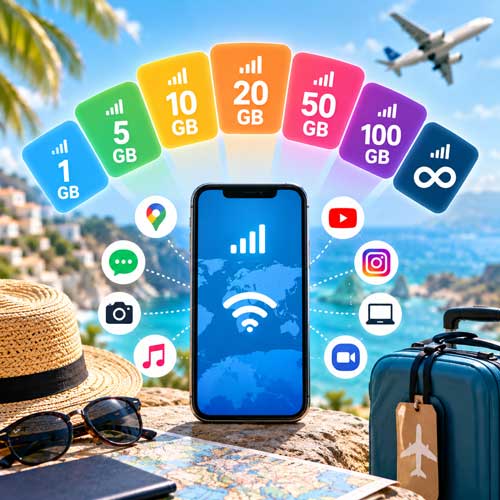
Why Travel Data Usage Is Different for Everyone
Two people can spend seven days in exactly the same destination and use completely different amounts of mobile data.
One traveller may only use Google Maps, WhatsApp, email and restaurant searches. Another may spend hours watching TikTok and YouTube, upload videos, make video calls and share the connection with a laptop.
The destination may be the same — but their mobile data requirements are completely different.
Calculate Your Data Per Day
Instead of looking only at the total number of gigabytes, calculate how much data you are likely to use each day.
A simple formula is:
Estimated daily data × number of travel days + safety margin
If you expect to use around 1 GB per day during a 10-day trip, that equals 10 GB. Choosing 15–20 GB instead can give you extra flexibility for unexpected navigation, video calls or uploads.
Is 1 GB Enough for Travel?
1 GB is a small travel allowance. It can work for a short trip if your phone is mainly a practical travel tool rather than an entertainment device.
It is best suited to messaging, email, occasional navigation, airline apps, hotel information, taxi apps and light browsing.
Is 5 GB Enough for Travel?
5 GB can be a practical choice for a short holiday or a traveller who mainly uses essential online services.
It gives much more freedom than 1 GB for maps, messaging, browsing, photo sharing and moderate social media, but frequent video viewing can still use it quickly.
Is 10 GB Enough for a Holiday?
10 GB is a useful starting point for many ordinary travellers. It provides comfortable access to maps, messaging, browsing, social media and occasional video without moving immediately into a very large package.
For a seven-day holiday, 10 GB gives an average of approximately 1.4 GB per day.
Is 20 GB Enough for Travel?
20 GB gives significantly more freedom for travellers who regularly use social media, video calls and occasional streaming.
It can be a good choice for people who want to stay connected throughout the day without constantly searching for Wi-Fi.
Who Should Consider 50 GB?
50 GB is aimed at much heavier users. It gives significantly more freedom for video, social media, video calls, content uploads and occasional hotspot use.
It can also be useful on longer trips where mobile data becomes your main internet connection.
Who Should Consider 100 GB?
100 GB becomes relevant when mobile internet is no longer just a travel convenience. It may be your main connection for work, entertainment, communication and everyday life.
Remote workers, long-term travellers, frequent video streamers and hotspot users are much more likely to benefit from this level of data.
When Should You Consider an Unlimited eSIM?
Unlimited mobile data becomes attractive when your consumption is consistently high, difficult to predict or essential for work and everyday life.
It can also be convenient for people who do not want to continuously monitor how many gigabytes remain during a long journey.
Unlimited eSIM for International Truck Drivers
Truck drivers can spend weeks travelling through multiple countries and may depend on mobile internet every day.
Navigation and traffic information may run throughout the working day. Messaging, company communication, weather information and route planning add further usage. During rest periods, the same connection may be used for video calls, social media, YouTube or streaming.
This creates a very different usage profile from a tourist spending seven days abroad.
Unlimited eSIM for Digital Nomads
Digital nomads can depend on mobile internet for their income. Email and web browsing may use relatively little data, but video meetings, cloud applications, large file transfers and hotspot use can quickly change the calculation.
When hotel, apartment or café Wi-Fi is unreliable, mobile data may also become an important backup connection.
Mobile Data for People Working Abroad
Someone working abroad for several weeks or months usually has different needs from a tourist.
Mobile internet may be used every day for work communication, banking, navigation, messaging, video calls with family, entertainment and administration. Over a 30-day period, even moderate daily consumption can add up to a substantial amount of data.
Content Creators and Influencers
Content creators can be among the heaviest travel data users. They do not only consume video — they also upload it.
High-resolution videos, Stories, Reels, TikTok uploads, cloud backups and LIVE broadcasts can create very large mobile data transfers. For an active creator, a small 5 GB or 10 GB travel package may be far too restrictive.
LIVE Streaming Can Change the Calculation Completely
LIVE streaming continuously transfers video over your mobile connection. Usage depends on the platform, resolution, bitrate and length of the broadcast.
Someone who broadcasts LIVE regularly should not choose an eSIM based on the needs of an ordinary tourist. Heavy LIVE streaming can make even a large fixed data allowance disappear quickly.
Hotspot Users Need to Think Differently
Connecting a laptop or another device to your phone can significantly increase consumption. Computers may download software updates, synchronise cloud files, stream high-resolution video or transfer large work files in the background.
Always check whether your chosen eSIM allows hotspot or tethering and whether a separate hotspot allowance applies.
Families Can Use Data Faster Than Expected
If several people share one mobile connection, data consumption can increase rapidly. One device may be navigating while another watches video and a third uses social media.
Where hotspot sharing is supported, calculate the likely usage of all connected devices rather than only the primary phone.
Google Maps Usually Needs Less Data Than Video
Maps and navigation are essential for many travellers, but they belong to a very different usage category from continuous video streaming.
Downloading offline maps before departure can reduce mobile data use further and provide useful backup navigation when coverage is weak.
Messaging Is Usually Light — Video Calls Are Not
Text-based WhatsApp, Messenger and similar messaging generally use relatively little data. Sending photos and voice messages uses more, while long video calls can substantially increase consumption.
This distinction is important for travellers who say they mainly use messaging apps but actually make frequent video calls.
Instagram, TikTok and Reels
Modern social media feeds contain large amounts of video. Spending hours scrolling through TikTok, Instagram Reels or Stories can therefore use significantly more data than maps, messaging or ordinary web browsing.
Heavy social media users should generally choose a larger allowance than travellers who mainly use their phone for navigation and communication.
YouTube, Netflix and Streaming
Video quality and viewing time have a major impact on data consumption. Watching occasional short videos is completely different from streaming several hours every evening.
Travellers who use YouTube, Netflix or other streaming platforms as their main entertainment should consider larger data packages.
Uploads Can Use Just as Much Data as Downloads
Travellers often think only about watching videos, but uploading content also uses mobile data.
High-resolution travel videos, cloud photo backups and large work files can generate substantial data usage. This is especially important for influencers, photographers, creators and remote workers.
Unlimited Does Not Always Mean Unlimited at Maximum Speed
The word Unlimited does not automatically mean unlimited data at maximum possible speed under every condition.
Different eSIM packages can apply different network-management or usage conditions. Always check the specific package before purchasing.
What Is FUP?
FUP stands for Fair Usage Policy. Some unlimited mobile products apply fair-use conditions to unusually high consumption or network use.
The exact rules depend on the individual product. Never assume that every Unlimited eSIM has the same FUP, speed or hotspot conditions.
Do You Really Need Unlimited Data?
Not everyone needs an Unlimited eSIM. If you are travelling for five days and mainly use maps, messaging and email, a smaller package may be perfectly adequate.
Unlimited becomes more useful when your consumption is high, unpredictable or important for your work and everyday connectivity.
How to Reduce Mobile Data Usage While Travelling
Download large files before departure whenever possible. Offline maps, music, films and playlists can all reduce your mobile data requirement.
Also review cloud backup, automatic application updates and cellular video quality before travelling with a limited package.
Do Not Choose Only by the Number of Gigabytes
Data allowance is important, but it is not the only factor when choosing a travel eSIM.
Also consider destination coverage, validity, network availability, speed conditions, hotspot support, activation rules and any Fair Usage Policy.
Is 1 GB enough for travelling?
1 GB can be enough for a short trip with very light use such as messaging, email, maps and occasional browsing. Frequent video, video calls or social media can require considerably more.
Is 5 GB enough for a one-week holiday?
5 GB can be enough for a light user who mainly uses maps, messaging, browsing and moderate social media. Travellers who regularly watch video should consider a larger allowance.
Is 10 GB enough for seven days abroad?
For many moderate travellers, 10 GB can provide a comfortable allowance for maps, messaging, browsing, social media and occasional video. Heavy TikTok, Reels, YouTube or video-call use can require more.
Is 20 GB enough for two weeks?
20 GB provides an average of approximately 1.4 GB per day over fourteen days. This can work well for moderate use, while heavy video consumption may require a larger package.
Is 50 GB a lot for travel?
50 GB is a large allowance for many ordinary tourists, but it can be appropriate for heavy social media users, frequent video calls, streaming, content uploads, hotspot use or longer trips.
Who should consider 100 GB or Unlimited?
Large allowances can be particularly useful for international truck drivers, digital nomads, people working abroad, content creators, LIVE streamers, remote workers, heavy video users and frequent hotspot users.
Does LIVE streaming use a lot of mobile data?
LIVE streaming can consume substantial amounts of data because video is continuously transmitted over the mobile connection. Usage depends on resolution, bitrate, platform and broadcast duration.
Can I use an Unlimited eSIM as a hotspot?
It depends on the specific eSIM package. Some products allow tethering normally, while others restrict hotspot use or provide a separate hotspot allowance. Check the package conditions before purchase.
Is Unlimited eSIM data always unlimited at full speed?
Not necessarily. Unlimited packages can have Fair Usage Policies, high-speed allowances, fixed maximum speeds or speed reductions. Always check the specific product conditions.
How much data does a truck driver need in Europe?
There is no single amount. A driver using navigation, communication, video calls, social media and streaming every day for several weeks can require much more data than a short-term tourist. Large regional packages or suitable Unlimited plans may therefore be worth considering.